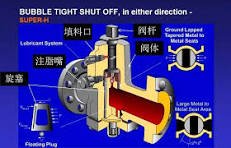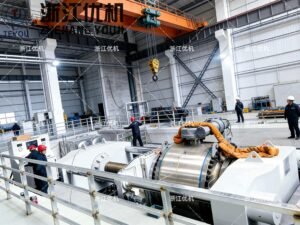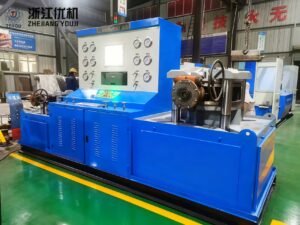
I. Core Classifications and Functions of Safety Testing Benches
1. Structural Safety Testing Benches
Types | Functional Characteristics | Test Object Examples
Static Load Testing Bench | Simulates long-term static pressure, detects deformation/fracture limits
Building components, bridge bearings
Fatigue Testing Bench | High-frequency cyclic loading, evaluates material fatigue life (up to tens of millions of cycles)
Aircraft engine blades, automobile chassis
Impact Testing Bench | Transient impact testing (e.g., drop hammer, collision), analyzes impact resistance performance
Safety helmets, bulletproof glass
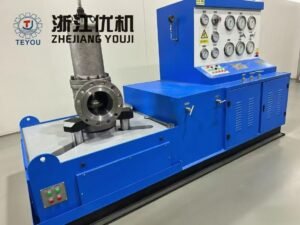
2. Electrical Safety Testing Benches
Types | Core Functions | Standards
Insulation Withstand Voltage Testing Bench | Applyes high voltage (AC/DC) to detect insulation failure voltage
IEC 61010-1
Grounding Resistance Testing Bench | Measures equipment grounding continuity (usually requires ≤0.1Ω)
GB 4706.1
Leakage Current Testing Bench | Monitors leakage current during normal operation (medical equipment requires <0.1mA)
IEC 60601-1
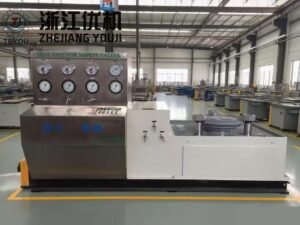
3. Environmental Reliability Testing Benches
Types | Simulate Environmental Conditions | Typical Application Areas
Salt Spray Chamber | 5% NaCl solution spraying, accelerating corrosion testing
Automotive parts, marine materials
High and low temperature humidity test chamber
-70℃
150℃ temperature change, 20% humidity
98% controllable
Electronic components, aerospace
IP protection rating test bench
Water spray (IPX5), dust (IP6X) intrusion protection verification
Outdoor electrical equipment

4. Functional safety test bench
Safety interlock test bench: Verifies the reliability of emergency stop buttons, light curtains, and other protective devices (response time ≤100ms)
PLC safety logic verification bench: Tests safety control systems (e.g., SIL3 certification) through fault injection (e.g., signal disconnection)
II. Core uses and value
1. Product compliance certification
Mandatory certification: Essential testing for certifications such as CCC (China), UL (USA), CE (EU)
Industry standards: Automotive (ISO 26262), Machinery (ISO 13849), Medical (IEC 62304)
2. Failure analysis and improvement
Defect location : Reproduce faults through testing (e.g., battery thermal runaway, structural cracking)
Optimize design: Improve weak points based on test data (e.g., add redundant structures)
3. Life prediction and maintenance
Accelerated life testing: Estimate product lifespan through high temperature/high humidity conditions (e.g., 100,000-hour life verification of LED lights)
Preventive maintenance: Monitor the performance degradation of key components (e.g., vibration testing of wind turbine bearings)
III. Typical Industry Application Cases
Industry
Test Bench Type
Specific Application Scenarios
New Energy Vehicles
Battery Safety Test Bench
Needle penetration/overcharge/thermal spread testing (GB 38031-2020)
Medical Devices
Biocompatibility Test Bench
Cytotoxicity testing (ISO 10993-5)
Smart Home
Flame Retardant Test Bench
Material flammability rating testing (UL94 V-0)
Power Equipment
Short Circuit Withstand Test Bench
Verification of 50kA/1s short circuit current carrying capacity of switchgear
IV. Key Selection Parameter Guide
Load Capacity Static test bench must withstand ≥200% of the product’s ultimate load (e.g., 500kN for elevator traction machine testing).
Accuracy Class: Force sensor accuracy ±0.5%FS, temperature control ±0.5℃.
Data Acquisition: Sampling rate ≥1kHz (≥100kHz for impact testing).
Safety Configuration: Explosion-proof chamber (explosion test), dual-circuit emergency stop, gas fire suppression system.
Industry Trends:
Intelligentization: AI fault diagnosis (e.g., automatic vibration spectrum analysis).
Integration: Multi-physics coupling testing (thermal-mechanical-electrical combined test bench).
Green Development: Energy recovery test bench (braking energy feedback grid).